


Since you work in marketing, you’re well aware of the bad rap marketing technology gets from time to time.
Many of the features in martech solutions go unused.
That’s true, but it’s true of software in general, not just martech tools. You’re only using a fraction of the capabilities of your web browser, email client and productivity software too.
We can’t accurately measure the ROI of our martech investments.
The chances are pretty good you can’t accurately measure the ROI on many of your marketing investments (and your tech investments while we’re at it). Sure, your attribution tools are telling you what they think is happening, but they’re not foolproof and the customer journey is almost always more complicated and circuitous than we like to believe.
Surveys say: Data is getting a lot of attention from marketers
Two new surveys examining the martech landscape shed a bit of light on the relationship between marketers, martech and data.
Let’s start with our very own 2024 MarTech Replacement Survey (no registration required).
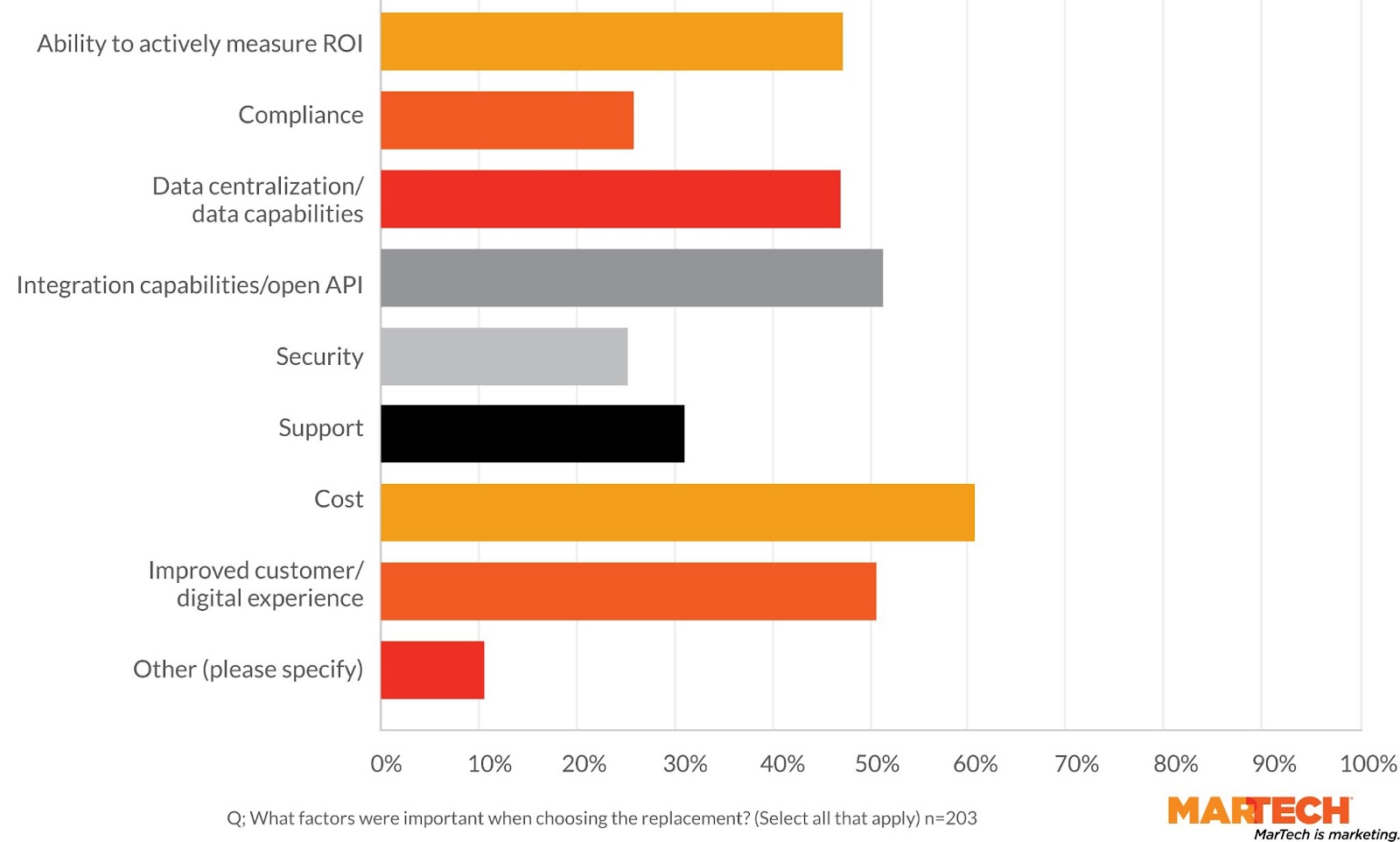
Perhaps the most significant difference between the 2023 and 2024 editions of the MarTech Replacement Survey was the role of cost when marketers were considering a replacement for a martech application.
Cost was cited by 37% of respondents in 2023 who replaced a martech solution in the past year. In 2024, it rose to 61%. That’s not surprising given the economic climate in B2B marketing, in particular, over the past year.
But a number of the important factors considered in replacements were related to data, and each of those factors rose from 2023 to 2024 as well.
- Integration capabilities/open API rose from 36% in 2023 to 51% in 2024.
- Data centralization/data capabilities rose from 35% in 2023 to 47% in 2024.
- Improved customer/digital experience rose from 38% in 2023 to 50% in 2024.
While the market for business software slowed down over the past two years, 57% of marketers responding to the 2024 MarTech Replacement Survey reported the number of applications in their martech stack actually rose by one to five solutions in the past year.
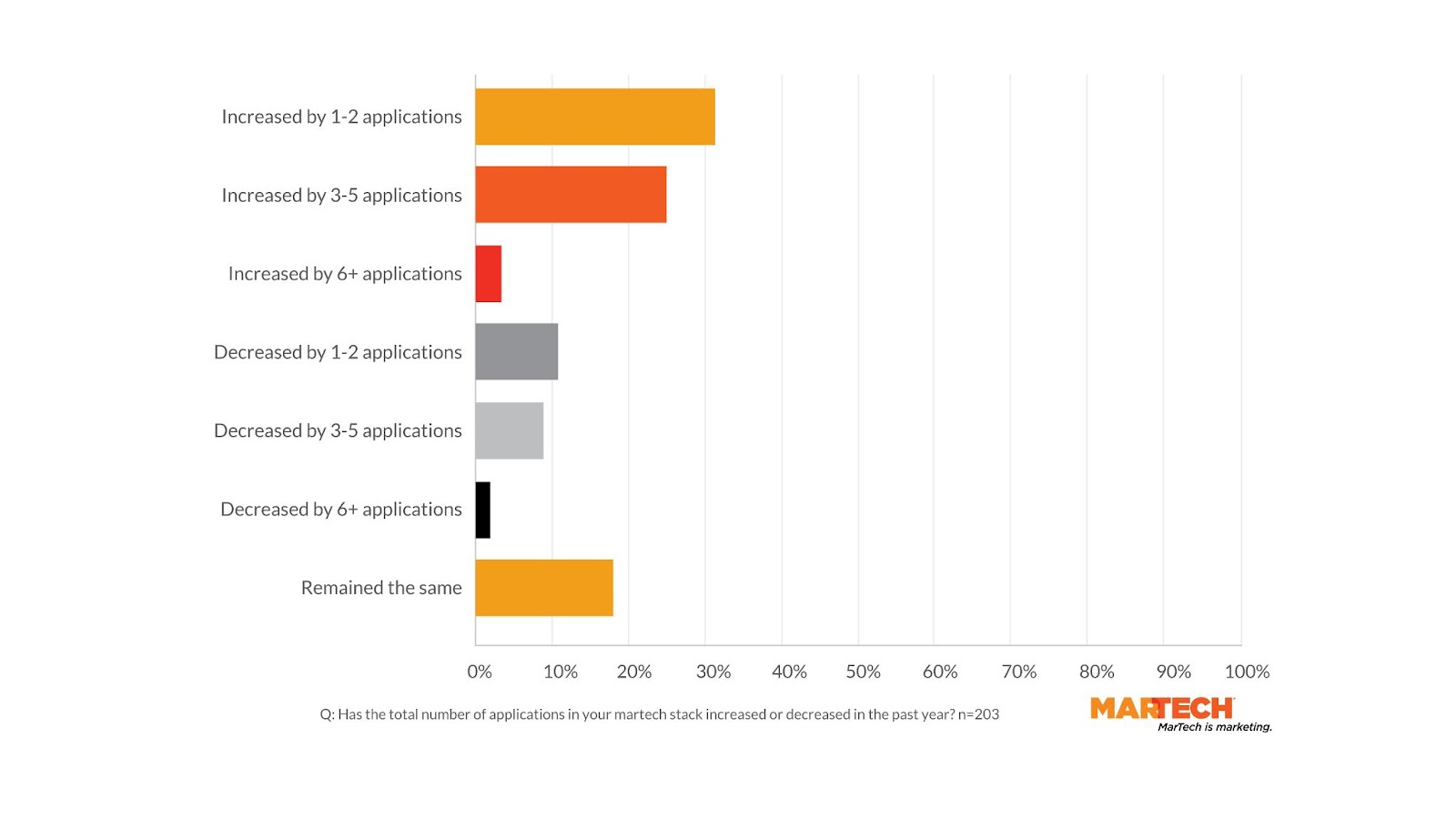
What we see in the Replacement Survey is that marketing organizations continue to grow their martech stacks and are looking closely at the cost and data capabilities of the tools when they consider replacing a solution.
Dig deeper: Features drive marketers to replace martech, but cost is top of mind for new apps
Now let’s bring in a second survey to consider.
A survey from Harvard Business Review Analytic Services sponsored by SAS (registration required) found customer trust was at the heart of many martech decisions.
It found 91% of the survey’s respondents consider customer trust to be very important to their organization’s success; 81 percent say martech has a significant or moderate impact on nurturing and fostering this trust.
Data, of course, plays a significant role in all of this. Data accuracy, data integration and data activation all help build trust with customers in their own way. Customers lose trust when, for example, a brand sends them messages or recommendations clearly based on inaccurate data.
That’s why data capabilities were so important to marketers looking at replacement solutions. Having accurate data flow through the martech stack is the dream, and according to the SAS-sponsored survey, it remains just a dream for many marketers.
More than one-third (38 percent) of respondents cited difficulty integrating new technologies into their existing stack as a barrier preventing martech from having a positive impact on customer trust for their organization.
Other data-related issues include:
- Poor data quality (37%).
- Silos of customer data (36%).
- Lack of real-time data access (29%).
There are, to be sure, other issues impacting customer trust, the survey found. They include inconsistent messaging across channels (31%), inadequate customer service (30%) and misalignment of marketing messaging and content with customer needs (30%). Data issues can impact each of these.
Is it your martech or your data
Are we splitting hairs here? I don’t think so. If you’re fond of the analogy comparing data to oil, there’s a difference between your car or truck and the gas or motor oil you put in it. Bad data and bad oil have the same impact: your engine doesn’t run properly.
If your martech solutions are difficult to integrate because they lack open APIs, that’s one problem. But even the best tools will fail when the data is bad.
If your martech investments aren’t moving the needle on your marketing, the relationship between your tools, your team and your data might be experiencing a rough patch. Take a look at each.
Your tools. Do they have the features and capabilities you need?
Your people. Are they properly trained on the tools? Are they properly configuring the tools?
Your data. Is it sitting in silos? Is it old or inaccurate? Is it available to the applications that need it?
This is where the case for composability is strong. Martech solutions that reach into data warehouses to tap into a single data source are gaining in popularity. These strategies put some space between the data and the martech application.
Marketers, martech and data. One of these often feels like a third wheel in this relationship and it’s not the same one in every organization. Which one is it for you?
Dig deeper: The truth behind martech stack composability
The post Does your marketing team have a martech problem or a data problem? appeared first on MarTech.
# Identifying the Root Cause: Is Your Marketing Team Facing a Martech Challenge or a Data Issue?
In today’s fast-paced, data-driven marketing landscape, businesses are increasingly reliant on technology and data to drive their strategies. Marketing teams are tasked with leveraging a wide array of tools, platforms, and data sources to reach their target audiences effectively. However, when things go wrong—whether it’s poor campaign performance, low customer engagement, or inefficient processes—the root cause can often be difficult to pinpoint. Is it a martech (marketing technology) issue, or is it a data problem?
Understanding the distinction between martech challenges and data issues is crucial for diagnosing and resolving problems efficiently. Let’s break down how to identify the root cause and what steps you can take to address each type of challenge.
## Martech Challenges: When Technology Fails to Deliver
### What is Martech?
Martech refers to the suite of software and tools that marketers use to plan, execute, and analyze marketing campaigns. This can include customer relationship management (CRM) systems, email marketing platforms, social media management tools, analytics software, and more. Martech enables marketing teams to automate tasks, streamline processes, and gain insights into customer behavior.
### Common Martech Challenges
While martech can be a game-changer, it can also present a number of challenges:
1. **Integration Issues**: One of the most common martech challenges is the inability to integrate different tools and platforms. For example, your CRM might not sync properly with your email marketing platform, leading to inconsistent customer data across systems.
2. **Tool Overload**: Many marketing teams suffer from “tool overload,” where they use too many platforms that don’t communicate well with each other. This can lead to inefficiencies, confusion, and wasted resources.
3. **Complexity and Usability**: Some martech tools are overly complex and difficult to use, especially for teams without specialized technical expertise. This can result in underutilization of the platform’s features or, worse, incorrect usage that leads to poor outcomes.
4. **Lack of Training**: Even the best tools are ineffective if your team doesn’t know how to use them. Lack of proper training on martech platforms can lead to errors, inefficiencies, and missed opportunities.
5. **Outdated Technology**: If your marketing team is using outdated or legacy systems, you may face limitations in functionality, scalability, or compatibility with newer tools.
### How to Identify a Martech Challenge
If your marketing team is facing issues, here are some signs that the problem may lie with your martech stack:
– **Disjointed Customer Journeys**: If your customers are receiving inconsistent messaging across different channels, it could be due to poor integration between your martech tools.
– **Manual Workarounds**: If your team is constantly resorting to manual processes to compensate for technology gaps, it’s a sign that your martech stack isn’t functioning as it should.
– **Low Adoption Rates**: If your team is not using certain tools or features, it could indicate that the platform is too complex or that they haven’t received adequate training.
– **Frequent Technical Glitches**: If your tools frequently crash or fail to deliver the expected results, you may be dealing with outdated or incompatible technology.
## Data Issues: When Information is the Problem
### What is a Data Issue?
Data issues refer to problems related to the quality, accuracy, or availability of the data that your marketing team relies on. In a world where data is king, poor data can lead to misguided decisions, ineffective campaigns, and wasted resources.
### Common Data Issues
Data problems can manifest in a variety of ways:
1. **Inaccurate Data**: If your customer data is outdated, incomplete, or incorrect, it can lead to poor targeting, irrelevant messaging, and missed opportunities.
2. **Data Silos**: Data silos occur when different departments or tools store data separately, making it difficult to get a unified view of the customer. This can lead to inconsistent messaging and a fragmented customer experience.
3. **Data Overload**: Having too much data can be just as problematic as having too little. If your team is overwhelmed by the sheer volume of data, they may struggle to extract meaningful insights.
4. **Lack of Data Governance**: Without proper data governance policies, your team may struggle with data inconsistencies, duplicate records, or compliance issues (e.g., GDPR violations).
5. **Poor Data Hygiene**: If your data isn’t regularly cleaned and maintained, it can quickly become outdated or irrelevant. This can lead to inaccurate reporting and misguided decisions.
### How to Identify a Data Issue
Here are some signs that your marketing team may be dealing with a data problem:
– **Inconsistent Reporting**: If your reports show conflicting numbers or results that don’t align with expectations, it could be due to inaccurate or incomplete data.
– **Poor Campaign Performance

Recent Comments