


For marketers to succeed with their customer marketing efforts, it’s essential to understand which customers are happy, which are at risk of churn and which present cross-sell and upsell opportunities.
Your customer data is full of clues to help you understand which customers fit into each of these buckets. You just need to mine that data to find the clues. Sounds simple, right? It hasn’t always been that way. Then along came generative AI.
If you’re like most people, you hear the term “genAI” and you think about content creation. But its capabilities are expanding and users are experimenting with more use cases.
For this article, I used the Google Gemini generative AI application to help me analyze customer data, identify customers that met certain criteria and receive recommendations and messaging to use with those customers.
Creating sample customer data with Google Gemini
Before I could analyze customer data, I needed to create it. I built a scenario with Gemini to essentially fabricate data in a spreadsheet for customers of a small B2B software company
I told Gemini the columns I wanted in the spreadsheet and provided ranges for some of the data in order to prevent some customers having lifetime revenue several multiple higher than others, for example.
The columns I chose to create were:
- Company name.
- Number of licenses for 2003 and 2004.
- Total time logged in the app (2003 and 2004).
- Average time logged in the app (2003 and 2004).
- Lifetime value.
- Customer supports costs (2023 and 2024).
- Average monthly support costs (2023 and 2024).
One of the memorable moments from this part of the exercise was when I decided to add year-over-year data so I could run comparisons. Gemini added 2023 and 2024 lifetime values for each customer. I pointed out that there is only one lifetime value, and Gemini immediately apologized for the error and fixed it.
All told, Gemini created sample data for 150 customers. Here is the sample data for eight of them.

Let’s dig into customer support costs
You can learn a lot by analyzing support costs. Customers with high support costs are at risk for churn. And customers that cost a vendor more in support than they bring in in revenue are bad deals that need to be fixed.
That’s why my first query was to ask Gemini how many of the 150 customers had higher support costs than revenue. Fortunately, none of them did, which is good news. Next, I wanted to know which customers had the highest support costs over the two years of data we created.
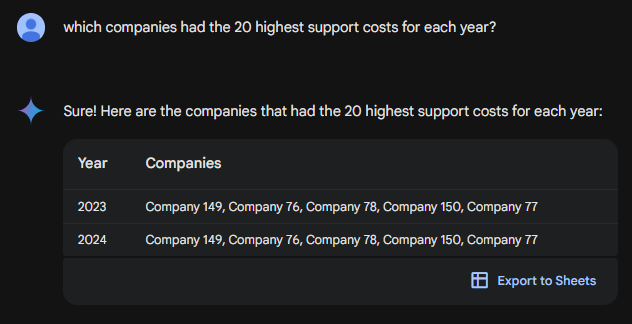
Note that for each year the same companies had the highest support costs, which could be an anomaly in our customer data, a misunderstood prompt or it could be a sign of a larger problem with the customers in question.
What do I say to customers whose support costs are killing us?
Since Gemini is a generative AI platform, it’s more than capable of taking the data and analysis and drafting relevant communications. So I asked Gemini to draft an email to send to customers with high support costs offering them resources to help.
Gemini’s initial draft cited the high support costs in the email, which I asked it to correct because it’s not wise to tell your customers “You’re costing us a ton in customer support!”
The second draft was closer to what I was looking for:
Dear [Customer Name],
We wanted to reach out to express our appreciation for your continued partnership with [Company Name]. We value your business and are committed to providing you with the best possible support.
To help you get the most out of our products and services, we’d like to offer you access to additional training and resources. These may include:
[Training Course 1]: [Brief description of the course]
[Training Course 2]: [Brief description of the course]
[Knowledge Base Article]: [Link to a relevant article]
These resources can help you and your team troubleshoot problems more efficiently, train new users effectively, and maximize the value you get from our products.
By taking advantage of these resources, you can potentially reduce the need for support interactions and optimize your overall support experience.
Please let us know if you’re interested in learning more about these resources or if you have any other questions. We’re here to support your success.
Let’s find those churn risks and get ’em fixed
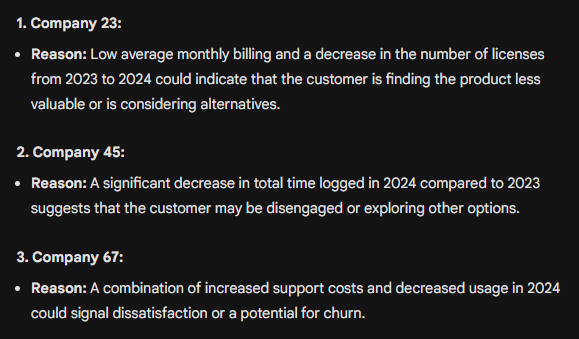
I asked Gemini to identify in the data the five customers most at risk for customer churn. It pointed out that it was capable of hypothesizing which customers were most at risk, but that additional data, like historic churn rates for example, would help identify risks more accurately.
Here’s a sample from the five customers it identified as churn risks and why.
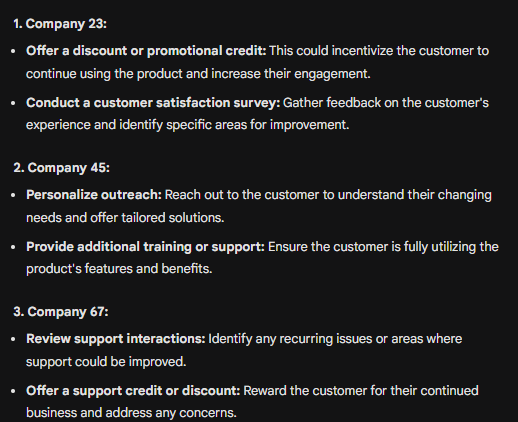
Identifying churn risks is only half (or even less) of the battle. So I asked Gemini to help me outline a retention strategy for these customers.
A loaded question: Who are the ‘best customers’?
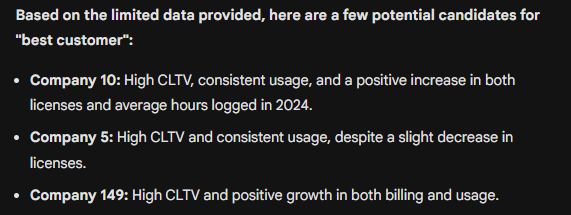
Everyone in customer marketing would love to know which of their customers are “the best customers.” But a lot goes into defining a “best customer.” And, as I expected, when I put the question of which customers from our dataset were “the best” and why, Gemini reminded me we’re working with a relatively simple dataset.
It could do an even better job of answering the query, it said, if it had information on:
- Customer satisfaction ratings.
- Product usage patterns.
- Churn history.
- Referrals made.
Nevertheless, Gemini took a shot at identifying the best customers based on the data we had around customer lifetime value (CLTV), support costs and engagement with the product.
What I learned from this exercise
The natural language capabilities of Gemini and other genAI applications are getting better. I didn’t need to create complicated prompts or ask Gemini to play a role. I simply asked it to do what I wanted it to do.
More than spitting out answers, however, Gemini added useful suggestions, such as additional data for our dataset that would be helpful, or suggestions around strategies.
I found Gemini’s role in this exercise to be part simulator and part mentor. We were using fabricated data, and while the exercise was fictitious, it was also very real. This could have been actual customer data and the results and suggestions would likely hold up. Even as a simulation, it made for a great thought exercise.
The suggestions and areas for improvement Gemini offered were similar to working with a more experienced mentor. Gemini was right in many cases. I didn’t add data like customer satisfaction scores, for example, or referrals. Nor did I take a shot at adding customer acquisition costs. That’s the type of feedback a more experienced marketer might deliver in a case like this.
My current plan is to keep the data on the 150 fictional customers and add to it. I’ll continue to ask Gemini to give me insights and suggestions. I can’t wait to see what I learn along the way.
Dig deeper: Meet my research team: Gemini, ChatGPT and Perplexity
The post How a free AI tool will help you develop a customer marketing strategy appeared first on MarTech.
# Leveraging a Free AI Tool to Enhance Your Customer Marketing Strategy
In today’s fast-paced digital landscape, businesses are constantly seeking ways to enhance their marketing strategies and stay ahead of the competition. One of the most significant advancements in recent years is the rise of artificial intelligence (AI) in marketing. AI-powered tools can help businesses streamline their marketing efforts, improve customer engagement, and drive better results. The best part? Many AI tools are available for free, making them accessible to businesses of all sizes. In this article, we will explore how you can leverage a free AI tool to enhance your customer marketing strategy.
## 1. Understanding AI in Marketing
Before diving into specific tools, it’s essential to understand how AI can impact marketing. AI can analyze vast amounts of data, identify patterns, and make predictions that help marketers make more informed decisions. It can also automate repetitive tasks, freeing up time for marketers to focus on strategy and creativity.
Some key applications of AI in marketing include:
– **Personalization**: AI can analyze customer data to deliver personalized content, offers, and recommendations.
– **Predictive Analytics**: AI can predict customer behavior, helping businesses anticipate needs and optimize campaigns.
– **Automation**: AI can automate tasks such as email marketing, social media posting, and customer segmentation.
– **Customer Insights**: AI can provide deep insights into customer preferences, behaviors, and sentiment.
Now, let’s explore how you can use a free AI tool to enhance your customer marketing strategy.
## 2. Choosing the Right Free AI Tool
There are several free AI tools available that can help you improve your marketing efforts. Some of the most popular options include:
– **ChatGPT by OpenAI**: A powerful natural language processing tool that can assist with content creation, customer support, and personalized messaging.
– **Google Analytics with AI-Powered Insights**: A free tool that uses AI to provide insights into website traffic, customer behavior, and marketing performance.
– **HubSpot’s Free Marketing Tools**: HubSpot offers free AI-driven tools for email marketing, lead generation, and customer relationship management (CRM).
– **Canva’s AI-Powered Design Tools**: Canva offers free AI-driven design tools that can help you create visually appealing marketing materials.
For the purposes of this article, we will focus on how you can use **ChatGPT by OpenAI** to enhance your customer marketing strategy.
## 3. Using ChatGPT to Enhance Your Customer Marketing Strategy
ChatGPT is a versatile AI tool that can assist with various aspects of your marketing strategy. Here are some practical ways to leverage ChatGPT to improve your customer marketing efforts:
### a. Content Creation
One of the most time-consuming aspects of marketing is content creation. Whether you’re writing blog posts, social media updates, or email newsletters, creating high-quality content can be a challenge. ChatGPT can help by generating content ideas, drafting copy, and even refining your messaging.
**How to Use ChatGPT for Content Creation:**
– **Generate Blog Ideas**: Ask ChatGPT to suggest blog topics based on your industry, target audience, or current trends.
– **Draft Blog Posts**: Provide ChatGPT with a brief outline or key points, and it can help you draft a complete blog post.
– **Write Social Media Posts**: ChatGPT can generate engaging social media captions, hashtags, and post ideas tailored to your audience.
– **Create Email Campaigns**: Use ChatGPT to draft personalized email content, subject lines, and calls-to-action.
By using ChatGPT for content creation, you can save time and ensure that your messaging is consistent and engaging.
### b. Personalization at Scale
Personalization is key to building strong customer relationships. However, personalizing content for each customer can be challenging, especially as your customer base grows. ChatGPT can help you deliver personalized messaging at scale by analyzing customer data and generating tailored content.
**How to Use ChatGPT for Personalization:**
– **Segment Your Audience**: Use customer data to segment your audience based on demographics, behavior, or preferences. Then, use ChatGPT to generate personalized content for each segment.
– **Create Dynamic Email Content**: ChatGPT can help you create dynamic email content that changes based on the recipient’s preferences or past interactions with your brand.
– **Generate Personalized Product Recommendations**: If you have an e-commerce business, ChatGPT can help you generate personalized product recommendations based on customer purchase history or browsing behavior.
By leveraging AI-driven personalization, you can create more meaningful connections with your customers and increase engagement.
### c. Customer Support and Engagement
Providing excellent customer support is essential for building customer loyalty. ChatGPT can be used to automate customer support tasks, such as answering frequently asked questions or providing product recommendations. Additionally, ChatGPT can assist with customer engagement by generating responses to customer inquiries on social media or via email.
**How to Use ChatGPT for Customer Support:**
– **Automate FAQs**

Recent Comments