


GenAI’s transformative power accelerates marketing objectives and unlocks growth. The benefits are clear: enhanced productivity, deeper data analysis, personalized experiences, content generation and more.
However, tapping into genAI’s full potential requires more than just adding another tool to the martech stack. Shifting from pilot projects to widespread implementation demands a strategic approach. One that supports change management across every element of the current workflow that needs to evolve.
Eight out of 10 marketing leaders expect genAI to positively impact marketing investment and strategy this year, per Gartner research. This growing optimism highlights the need to establish a clear roadmap for adopting genAI in marketing. The following four recommendations address how to manage these challenges.
1. Establish an AI council and demonstrate marketing’s role
Marketers don’t have to work on genAI implementation alone. Work cross-functionally to assemble an AI council to provide direction and drive strategy. This multidisciplinary team of decision-makers and experts throughout the organization should encourage responsible and effective adoption, focusing on everything from risk management to upskilling talent to building trust.
Actively engage in the council to show how AI adds business value. Focus on brand ownership and crafting unique customer messages and experiences as key benefits of genAI, linking AI investments to real business results. Position genAI as both a people and tech solution, emphasizing training and upskilling to prepare your team for AI.
2. Ensure data is AI-ready
Business leaders often underestimate the impact of data on outcomes. But for successful AI implementation, your data must be clean, consistent and well-structured. Data governance and metadata management should be directed at the enterprise level with guidance from the AI council.
Marketers should also ensure data quality aligns with marketing goals by following these steps:
- Identify your top marketing use case for genAI, honing in on the data critical to that case.
- Assign a marketing data champion to build best practices, encourage data sharing and oversee data quality.
- Collaborate with stakeholders and data owners to set data quality standards and plan to close gaps between current and ideal quality. Leaders should anchor data governance for genAI in business value, emphasizing accountability for customer data and brand intellectual property.
Many mistakenly believe you can simply feed an organization’s data into a genAI tool and get results. In reality, large language models and other AI engines rely heavily on metadata — data about data that comprises various forms of descriptions and attributes.
Metadata provides essential context and understanding of the underlying data. Your marketing data champion should work closely with data, analytics and technology leaders to identify and link metadata that will drive marketing’s productivity and effectiveness, focusing on use cases that can be augmented by genAI.
Dig deeper: How to make sure your data is AI-ready
3. Refine technology and talent mix
Assembling the right technology and talent mix depends on the organization’s:
- Desired outcomes.
- Risk appetite for investing in customization.
- Resources available to support implementation.
Carefully weigh the pros and cons of buying a genAI model or building your own. Most organizations take a hybrid approach to the tech mix as they experiment and move into pilots and implementation.
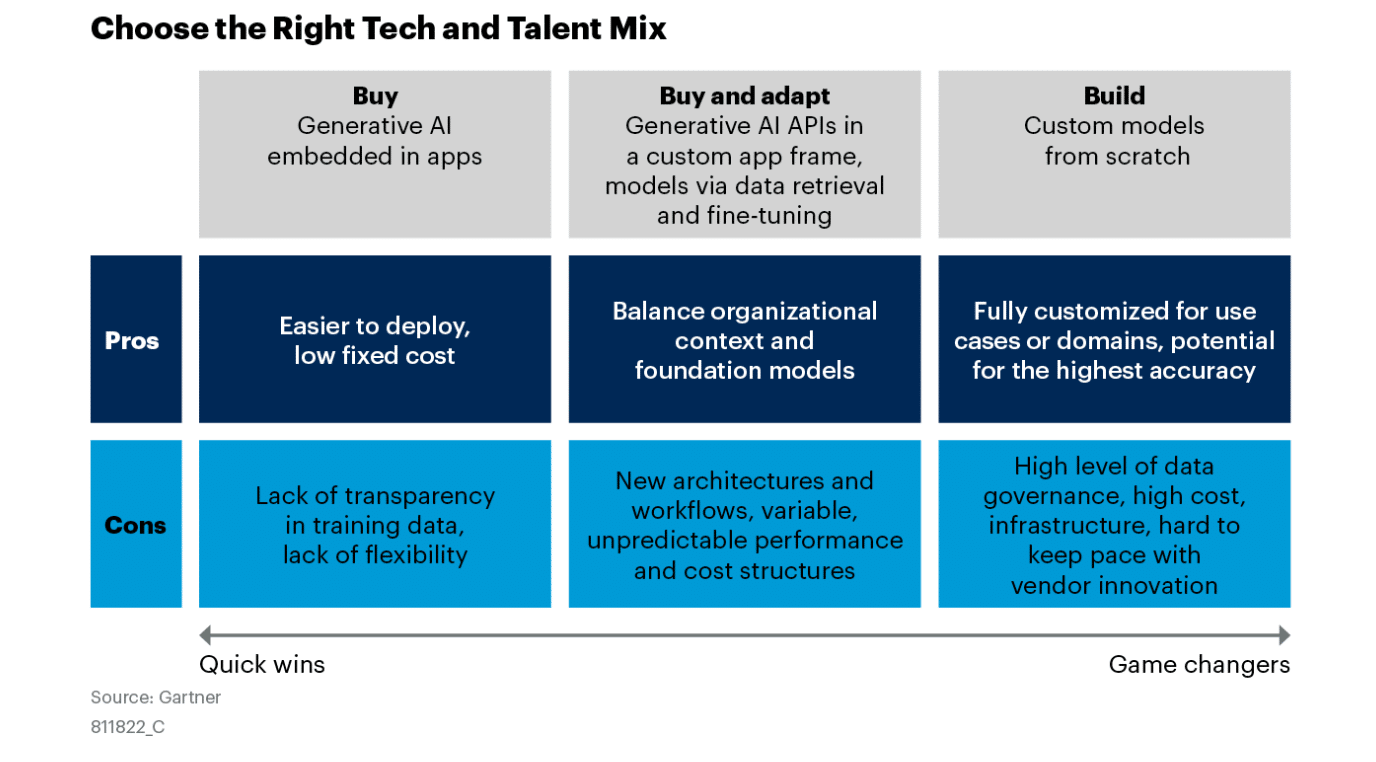
Whichever option you choose, upskilling talent is a must. The buy approach needs minimal training due to user-friendly models, while the build approach requires extensive training to design, develop and deploy the model.
Dig deeper: Weighing the pros and cons of out-of-the-box martech
4. Build customer trust
Building trust and long-term customer loyalty is crucial for marketing success. But concerns about content authenticity are growing in today’s AI-driven world. Gartner found that 70% of consumers believe AI-based content generators could spread false or misleading information.
Marketers must be transparent about genAI-created content. Deploy safeguards and establish risk mitigation policies to avoid high-threat scenarios undermining brand trust with this three-pronged approach:
Certify
- Establish processes to ensure the authenticity and accuracy of genAI-produced content to maintain consumer trust.
- For example, brands should disclose when using photographs of real people and places versus synthetic compositions.
Listen
- Broaden the scope of coverage for brand reputation management and monitoring, especially within social media.
- Prepare marketing teams to respond to and quickly address concerns over fake content.
Engage
- AI tools optimize workflows and enable companies to respond quickly to customer queries and concerns.
- Leaders must communicate the benefits of genAI implementation to showcase its value to both customers and stakeholders.
By following these steps to implement genAI and address its challenges, you can fully unlock its positive impact.
The post A marketer’s guide to implementing generative AI appeared first on MarTech.
# Comprehensive Guide for Marketers on Implementing Generative AI
In recent years, **Generative AI** has emerged as a transformative technology, revolutionizing industries by enabling machines to create content, generate ideas, and even simulate human creativity. For marketers, this presents a unique opportunity to leverage AI-driven tools to enhance campaigns, improve customer engagement, and streamline content creation. However, implementing generative AI effectively requires a thoughtful approach. This guide provides a comprehensive overview of how marketers can harness the power of generative AI to drive better outcomes.
## 1. **Understanding Generative AI**
Generative AI refers to a subset of artificial intelligence that can generate new content, including text, images, audio, and video, based on patterns it has learned from existing data. Unlike traditional AI, which focuses on analyzing and predicting, generative AI creates something new. Popular examples include **GPT-4** (for text generation), **DALL·E** (for image generation), and **ChatGPT** (for conversational AI).
### Key Benefits for Marketers:
– **Content Creation at Scale**: AI can generate blog posts, social media content, email campaigns, and product descriptions in a fraction of the time it would take a human.
– **Personalization**: AI can tailor content to individual customer preferences, improving engagement and conversion rates.
– **Cost Efficiency**: Automating repetitive tasks reduces the need for human intervention, saving time and resources.
– **Creative Assistance**: AI can provide inspiration for new ideas, headlines, or creative concepts.
## 2. **Applications of Generative AI in Marketing**
Generative AI can be applied across various marketing functions, from content creation to customer service. Here are some key areas where marketers can implement AI:
### a. **Content Creation**
Generative AI tools like **GPT-4** can write blog posts, articles, product descriptions, and even video scripts. Marketers can use these tools to:
– Generate high-quality content quickly.
– Create variations of existing content for A/B testing.
– Optimize content for SEO by generating keyword-rich copy.
### b. **Social Media Management**
AI can help marketers craft engaging social media posts, schedule them, and even respond to customer inquiries. Tools like **ChatGPT** can generate captions, hashtags, and responses to comments, allowing marketers to maintain an active social media presence without manual effort.
### c. **Email Marketing**
Generative AI can personalize email content based on user behavior, preferences, and demographics. AI-driven tools can:
– Create personalized subject lines and email body content.
– Segment audiences and tailor messages accordingly.
– Automate follow-up sequences based on customer interactions.
### d. **Ad Copy and Creative**
AI can generate ad copy for Google Ads, Facebook Ads, and other platforms. It can also create variations of ads to test different messaging and visuals. By analyzing performance data, AI can optimize campaigns in real-time.
### e. **Customer Support**
Chatbots powered by generative AI can handle customer inquiries, provide product recommendations, and resolve issues. This allows marketers to offer 24/7 support without the need for a large customer service team.
### f. **Market Research and Insights**
Generative AI can analyze vast amounts of data to identify trends, customer preferences, and emerging market opportunities. It can also generate reports and summaries, helping marketers make data-driven decisions.
## 3. **Steps to Implement Generative AI in Marketing**
While the potential of generative AI is vast, successful implementation requires a strategic approach. Here’s a step-by-step guide for marketers looking to integrate AI into their workflows:
### Step 1: **Identify Use Cases**
Start by identifying the areas of your marketing strategy where AI can add the most value. Consider tasks that are time-consuming, repetitive, or require large-scale content creation. Common use cases include content generation, email marketing, and customer support.
### Step 2: **Choose the Right Tools**
There are numerous generative AI tools available, each with its own strengths. Some popular options include:
– **OpenAI’s GPT-4**: For text generation, content writing, and conversational AI.
– **DALL·E**: For generating images from text prompts.
– **Jasper AI**: A content creation tool designed specifically for marketers.
– **Copy.ai**: A tool for generating marketing copy, including ads, emails, and social media posts.
Evaluate tools based on your specific needs, budget, and ease of integration with your existing marketing stack.
### Step 3: **Train and Fine-Tune AI Models**
While many generative AI tools come pre-trained, fine-tuning them on your specific data can improve their performance. For example, you can train an AI model on your brand’s tone of voice, product descriptions, and customer data to ensure the content it generates aligns with your brand identity.
### Step 4: **Test and Iterate**
Before deploying AI-generated

Recent Comments