


Do your customers feel like you’re giving them enough attention? Forty-four percent of Americans say they feel ignored by the media and most advertisers.
And it’s not that consumers aren’t hearing from brands. Part of the problem is they’re inundated with ads and worry about being tracked online. A full 67% of consumers said they hate being “trailed” by targeted ads. Seven out of 10 consumers said the ads are irrelevant despite being targeted.
These insights came from research by iHeartMedia in partnership with Malcolm Gladwell’s Pushkin Industries. Morning Consult, Advertiser Perceptions and Critical Mass Media also contributed to the research.
Why we care. It’s not only brand marketers who preach the importance of having a conversation with customers — the customers expect it, too. Both sides seek a connection that draws on shared values and beliefs. That means ensuring customers are approached with the right messages and ads, and knowing which customers are among the 44% that feel ignored.
Out-of-touch marketers. Consumers are aware that marketers have data on their interests and purchases. Irrelevant ads show that marketers are out of touch with customers despite all the information they have.
That’s at least the premise behind the divide in iHeartMedia’s study, which surveyed 237 marketers and nearly 4,000 consumers in separate polls. For instance, it found that consumers seek approval and conduct research to make purchases of $100 or more, while marketers make purchases exceeding $1,000 without permission from others and in a matter of hours or days.
“Today’s consumers are acutely aware of their social and economic environment and hold higher expectations for the brands that target them, sometimes relentlessly, based on the very traits that define their individuality,” said Gladwell, in a release.
Consumer values. Consumers also show more interest in certain personal values than marketers do. Here is the breakdown of how many in each cohort find specific values of the utmost importance.
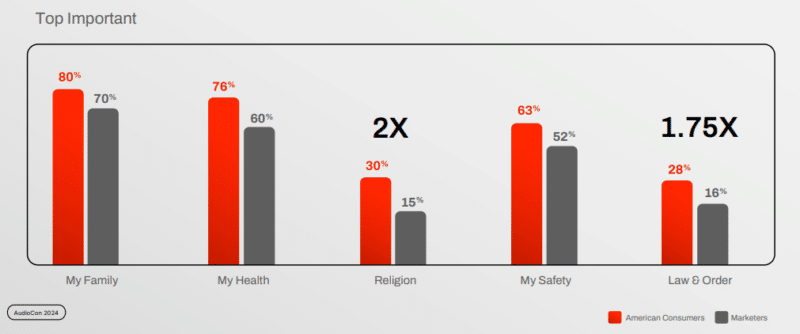
The proportion of consumers who find religion a “top important value” is twice as high as marketers (30% versus 15%). The disparity is nearly as great for “law and order” — 28% of consumers; 16% of marketers.
Opportunities. Brands that demonstrate they understand customers’ expectations and values can win over many customers who are, frankly, turned off.
Seventy-two percent of consumers said they don’t want to buy from brands that ignore them, and 75% are willing to pay more for brands that share their values.
The bottom line: Marketers need to pay more attention to customer values and preferences, so brands can take action. In a polarizing election year, it might even be worth the risk of weighing in on hot-button issues, if they align with your company’s values.
Dig deeper: Intense election ad buying could upend marketers’ holiday plans
The post Nearly half of US consumers feel ignored by marketers appeared first on MarTech.
**Survey Reveals Nearly 50% of US Consumers Feel Overlooked by Marketing Efforts**
In an era where personalization and customer-centric strategies are touted as the gold standard in marketing, a recent survey reveals a surprising disconnect between brands and their audiences. According to the study, nearly 50% of US consumers feel overlooked by marketing efforts, suggesting that businesses may not be as in tune with their customers’ needs and preferences as they believe.
This finding raises important questions about the effectiveness of current marketing strategies and highlights the growing demand for more personalized, inclusive, and relevant communication from brands. As companies continue to invest in data-driven marketing technologies, the results of this survey suggest that many are still falling short in making meaningful connections with their target audiences.
### Key Findings of the Survey
The survey, conducted by a leading market research firm, polled 2,000 US consumers across various demographics, including age, gender, income level, and geographic location. The results revealed several key insights:
1. **Lack of Personalization**: 48% of respondents said they feel that the marketing messages they receive are generic and do not speak to their individual needs or interests. Despite the widespread use of customer data and sophisticated targeting tools, many consumers feel that brands are not making the effort to understand them on a personal level.
2. **Demographic Disparities**: Certain demographic groups, including older consumers and those from minority backgrounds, reported feeling especially overlooked. For example, 60% of consumers aged 55 and older said they rarely see marketing campaigns that resonate with them, while 58% of Hispanic and African American respondents expressed a similar sentiment.
3. **Over-Saturation of Ads**: Another common complaint was the sheer volume of marketing messages. Nearly 65% of respondents said they feel bombarded by ads, with many noting that the constant stream of irrelevant content makes them tune out altogether. This suggests that while brands are investing heavily in digital advertising, they may be focusing more on quantity than quality.
4. **Desire for Inclusivity**: A significant portion of respondents, particularly younger consumers, expressed a desire for more inclusive marketing. Nearly 70% of Gen Z respondents said they are more likely to engage with brands that reflect diverse perspectives and values. This underscores the importance of representation in marketing campaigns, not just in terms of race and ethnicity, but also gender, sexual orientation, and body type.
5. **Trust and Authenticity**: Trust remains a critical factor in consumer-brand relationships. Over 40% of respondents said they feel that many brands are inauthentic in their marketing efforts, often prioritizing sales over genuine connection. Consumers are increasingly looking for brands that align with their values and demonstrate transparency in their messaging.
### The Disconnect Between Brands and Consumers
The findings of this survey point to a significant disconnect between how brands perceive their marketing efforts and how consumers experience them. While many companies believe they are delivering personalized, relevant content, nearly half of their audience feels ignored or misunderstood.
One possible explanation for this gap is the over-reliance on automation and algorithms in marketing. While data-driven tools can help brands target specific audiences, they often lack the nuance required to create truly personalized experiences. For example, a consumer may receive an ad based on their browsing history, but if the message doesn’t align with their current needs or values, it may come across as irrelevant or even intrusive.
Additionally, many brands are still using outdated demographic assumptions to guide their marketing strategies. For instance, older consumers are often stereotyped as being less tech-savvy or uninterested in certain products, leading to a lack of engagement with this demographic. Similarly, minority groups may feel underrepresented or misrepresented in marketing campaigns, which can alienate potential customers.
### The Importance of Personalization and Inclusivity
In today’s competitive marketplace, personalization is no longer a “nice-to-have”—it’s a necessity. Consumers expect brands to understand their preferences, anticipate their needs, and deliver relevant content at the right time. When done correctly, personalized marketing can lead to higher engagement, increased loyalty, and ultimately, better business outcomes.
However, personalization goes beyond simply addressing a customer by name in an email. It requires a deep understanding of the customer’s journey, preferences, and values. Brands that invest in building this understanding will be better positioned to create meaningful connections with their audience.
Inclusivity is another critical factor in modern marketing. As the US population becomes increasingly diverse, consumers are looking for brands that reflect their identities and values. This means not only featuring diverse individuals in marketing campaigns but also ensuring that the messaging is culturally sensitive and relevant to different communities.
### How Brands Can Bridge the Gap
To address the concerns raised by the survey, brands need to rethink their approach to marketing. Here are a few strategies that can help bridge the gap between brands and consumers:
1. **Leverage Data Responsibly**: While data is a powerful tool for personalization, it should be used thoughtfully

Recent Comments